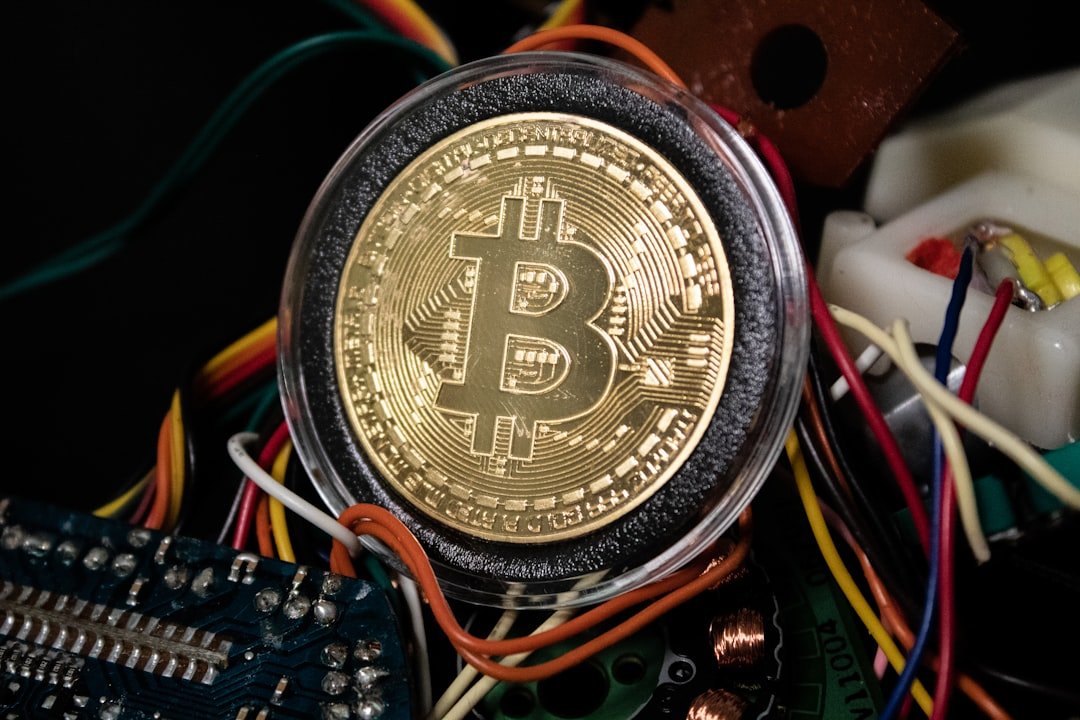
Photo by Brian Wangenheim on Unsplash
Beyond the Bitcoin Buzz: Unpacking Blockchain's True Potential
Hey there, fellow explorer of the digital frontier!
You know, it’s funny how often I hear people say, "Oh, blockchain? That's just for Bitcoin, right? Or maybe some other speculative crypto." It’s like looking at the internet in the early 90s and thinking, "Ah, it’s just for sending emails and looking up obscure facts." We were barely scratching the surface then, and frankly, many are still barely scratching the surface of what blockchain truly is today.
Let me tell you a quick story. Imagine you’re at a bustling farmers' market, a truly vibrant place. You pick up a ripe, red tomato. You ask the farmer, "Where did this come from?" They point to a field just a few miles away. You trust them. But what if you’re at a massive supermarket, holding a piece of exotic fruit, and you want to know its journey? Was it grown sustainably? Was fair labor used? How many hands touched it? Suddenly, that simple question becomes incredibly complex, shrouded in a web of international logistics, certifications, and data silos. You're left with a feeling of uncertainty, a gap in trust.
This feeling of uncertainty, this craving for verifiable truth and transparency, isn't just about fruit. It permeates nearly every industry, every transaction, every interaction where trust is paramount but often elusive. And that, my friends, is precisely where the true magic of blockchain technology steps onto the stage, far beyond the volatile world of crypto trading. It's about building a new kind of trust, a verifiable, immutable record that transcends geographical boundaries and institutional silos.
For years, the narrative around blockchain has been dominated by cryptocurrencies. And for good reason – Bitcoin was its groundbreaking genesis. But to confine blockchain to just digital money is like saying a car is only good for driving to the grocery store. It's a fundamental misunderstanding of the underlying engine, the revolutionary mechanics beneath the hood. Today, we're going on a journey to explore that engine, to understand how blockchain is quietly, yet profoundly, reshaping industries, redefining trust, and laying the groundwork for a more transparent and efficient future. Get ready to see the world through a new lens, one block at a time.
The Bedrock of Trust: Unpacking the Blockchain Fundamentals
Before we dive into the fascinating applications, let’s quickly revisit the core concept, but with a fresh perspective. Think of blockchain not as a digital currency, but as a revolutionary type of ledger. Not just any ledger, mind you, but one that is:
- Distributed: Instead of one central bank or company holding all the records, copies of the ledger are shared across a vast network of computers. Everyone involved has a synchronized copy. Imagine a shared Google Doc that no single person can delete or alter without everyone else seeing it and agreeing.
- Immutable: Once a record (a "block" of information, like a transaction or a data entry) is added to the chain, it's virtually impossible to change or delete it. Each new block is cryptographically linked to the previous one, forming an unbroken chain. Trying to alter an old record would break this chain, making the tampering immediately obvious to the entire network. It's like a digital notarization service that works continuously, stamping every new entry with an unchangeable seal.
- Transparent (within limits): While individual identities can be pseudonymous, the transactions and data entries themselves are typically visible to all participants on the network. This shared visibility fosters an unprecedented level of transparency and accountability.
- Secure: The cryptographic hashing and distributed nature make it incredibly resilient to fraud and cyberattacks. There's no single point of failure to target.
This combination creates a system where trust doesn't need to be placed in a single entity (like a bank or a government), but rather in the mathematical integrity of the network itself. It's a powerful shift from "trust me" to "let's verify together."
Beyond Digital Gold: Blockchain's Real-World Transformation Engine
Now, let's venture into the exciting territory where blockchain is truly making waves, far from the daily price swings of Bitcoin and Ethereum. These are the applications that are building efficiency, transparency, and trust into the very fabric of our global systems.
Remember our supermarket fruit example? Blockchain is addressing that exact problem head-on in supply chains. Imagine a world where you could scan a QR code on a bag of coffee and instantly see its entire journey: from the specific farm in Colombia where the beans were harvested, to the processing plant, the shipping container, the roasting facility, and finally, the distributor that brought it to your local store.
This isn't science fiction; it's happening. Companies like IBM, in collaboration with major retailers and food producers, have launched initiatives like IBM Food Trust. This platform uses blockchain to create an immutable record of food products as they move from farm to shelf. If there's a contamination issue, instead of weeks of tracing, companies can pinpoint the source in seconds, limiting outbreaks and reducing waste.
But it’s not just about safety. This transparency empowers consumers to make informed choices about sustainability, ethical sourcing, and product authenticity. For high-value goods like luxury items or pharmaceuticals, blockchain can combat counterfeiting, ensuring that what you buy is truly what it claims to be, protecting both brands and consumers. Imagine buying a designer handbag and being able to verify its entire provenance on a blockchain, proving its authenticity beyond a shadow of a doubt. This isn't just cool; it's a massive leap in consumer confidence and brand protection.
Our health records are perhaps some of the most sensitive and fragmented data we possess. They're scattered across different doctors, hospitals, and insurance providers, often inaccessible or difficult to share securely when needed most. Blockchain offers a compelling solution.
Picture this: your medical history, while still private and under your control, exists as an encrypted, immutable record on a blockchain. When you visit a new specialist, you can grant them temporary, permissioned access to specific parts of your record with a few taps on your phone. No more faxing, no more lost files, no more repeating your entire medical history.
Projects like MedicalChain are exploring how blockchain can give patients greater control over their health data, while simultaneously enabling secure sharing for research, streamlining insurance claims, and improving drug traceability within the pharmaceutical supply chain to prevent counterfeit medications from entering the market. This isn't about exposing your data; it's about empowering you to manage who sees what, when, and for how long, all while maintaining an unalterable audit trail.
In our increasingly digital world, our identity is fragmented across countless platforms. We have social media profiles, government IDs, work credentials, and more, all managed by different central authorities. This makes us vulnerable to data breaches and gives us little control over our own digital selves.
Self-sovereign identity (SSI) using blockchain aims to change this. Imagine a digital wallet on your phone containing verifiable credentials (your driver's license, university degree, professional certifications) issued by trusted authorities. Instead of handing over your physical ID or giving a company full access to your data, you can selectively prove specific attributes. Need to prove you're over 18? You can do so without revealing your birthdate, address, or even your name – just the "over 18" attribute, cryptographically verified by the issuing authority on the blockchain.
Companies like Trinsic are building platforms that enable individuals to own and control their digital identities. This drastically reduces the risk of identity theft, streamlines online verification processes, and puts the individual, not the corporation, back in control of their personal data. It’s a fundamental shift in how we interact with the digital world, moving towards a more private, secure, and user-centric experience.
Buying or selling property is notoriously slow, expensive, and bogged down by intermediaries and paperwork. Blockchain has the potential to transform real estate. Imagine a property deed as a digital token on a blockchain. Transferring ownership could happen almost instantly, reducing transaction costs, eliminating title fraud, and enhancing transparency.
Furthermore, blockchain enables asset tokenization, where real-world assets – be it a piece of art, a share in a building, or even a rare vintage car – are represented by digital tokens. This allows for fractional ownership, meaning you could own a tiny, verifiable piece of a high-value asset that was previously inaccessible to the average investor. This democratizes investment opportunities and creates new liquidity for illiquid assets. Platforms like Polymath are pioneering the creation and management of security tokens, paving the way for a future where virtually any asset can be tokenized and traded securely and efficiently.
The Power of Smart Contracts: Code is Law
One of the most profound innovations within the blockchain ecosystem, beyond the distributed ledger itself, is the concept of smart contracts. Think of them as self-executing agreements. These are lines of code stored on a blockchain that automatically execute when predefined conditions are met. No lawyers, no intermediaries, no delays.
Let's use a simple analogy: a vending machine. You put in your money (condition met), the machine verifies it, and dispenses your soda (action executed). A smart contract works similarly but on a much grander, more complex scale, and without the need for a central operator.
Consider an insurance claim for a delayed flight. Traditionally, you file a claim, submit proof, and wait for an adjuster to review it. With a smart contract, if your flight (tracked by an oracle, a data feed that brings real-world information onto the blockchain) is delayed by more than two hours, the smart contract automatically triggers a payout to your digital wallet. No paperwork, no phone calls, just instant, pre-agreed compensation.
Smart contracts are the backbone of most decentralized applications (dApps) and have endless potential: Automated Escrow: Funds are held in a smart contract and released only when both parties fulfill their agreed-upon obligations. Supply Chain Automation: Payments to suppliers can be automatically released upon verified delivery of goods. Royalty Distribution: Musicians or artists can have their royalties automatically distributed to all contributors every time their work is used.
The implications are massive, promising to automate trust and dramatically reduce friction and costs in countless industries.
The Institutional Embrace: Enterprise Blockchain in Action
While public blockchains like Bitcoin and Ethereum paved the way, many large corporations and institutions initially hesitated due to concerns about privacy, scalability, and regulatory clarity. This led to the rise of enterprise blockchains – often private or consortium-based networks designed to meet specific business needs.
Why are major players like Walmart, Maersk, and JP Morgan investing heavily in blockchain? Because the benefits of transparency, efficiency, and security are simply too compelling to ignore. They’re building solutions for:
Trade Finance: Streamlining the complex, multi-party process of international trade, reducing processing times from days to hours. Cross-Border Payments: Making international money transfers faster and cheaper, challenging the traditional banking system. Data Sharing: Creating secure, auditable ways for competitors or partners to share sensitive data without compromising proprietary information.These aren't speculative ventures; they're foundational shifts in how global commerce operates. The institutional embrace signifies a maturing of the technology, moving from experimental curiosity to essential infrastructure.
Practical Guidance: Navigating the Broader Blockchain Landscape
So, how can you engage with or understand this evolving landscape beyond the crypto market headlines?
- Educate Yourself Continuously: The space moves fast. Follow reputable blockchain news sources (like Crypto Basic Guide!), read whitepapers, and explore project websites. Look for industry-specific reports from consulting firms like Deloitte, PwC, and Gartner, which often detail enterprise blockchain adoption.
- Look for Real-World Problem Solving: When you hear about a new blockchain project, ask: "What real-world problem does this solve, and how does blockchain make it better than existing solutions?" If the answer isn't clear, it might be more hype than substance.
- Understand Different Blockchain Types: Not all blockchains are created equal. Public blockchains (like Ethereum) are open and permissionless. Private or consortium blockchains (like Hyperledger Fabric or Corda) are permissioned and often used by enterprises for specific purposes. Each has its strengths and weaknesses depending on the application.
- Explore dApps: Dive into decentralized applications (dApps) that aren't purely financial. Look for those focused on identity, social media, gaming, or content creation to see how blockchain-based governance and ownership work.
- Consider Your Data: Think about how blockchain applications related to identity and data management could impact your personal privacy and control in the future.
Common Pitfalls and Honest Challenges
It wouldn't be an honest conversation without addressing the hurdles. Blockchain isn't a silver bullet, and its widespread adoption faces significant challenges:
- Scalability: Public blockchains, especially, struggle with processing a huge number of transactions quickly without sacrificing decentralization. Solutions like layer-2 networks are emerging, but it's an ongoing challenge.
- Interoperability: Different blockchains often operate in silos. Getting them to talk to each other seamlessly is crucial for a truly interconnected future.
- Regulatory Uncertainty: Governments worldwide are still grappling with how to regulate blockchain technology and its applications, creating a patchwork of rules that can hinder global adoption.
- User Experience (UX): For many mainstream applications, the user experience of blockchain tools is still clunky and complex compared to traditional web services. This needs to improve dramatically for mass adoption.
- Energy Consumption: While often associated with specific proof-of-work cryptocurrencies, the overall energy footprint of blockchain technology is a concern that projects are actively working to address through more efficient consensus mechanisms.
- Human Factor: Technology is only as good as its implementation. Resistance to change, lack of understanding, and the need for new skill sets within organizations can slow adoption.
These aren't insurmountable problems, but they require continuous innovation, collaboration, and a willingness to adapt from all stakeholders.
Future Outlook: A Glimpse into Tomorrow
Where is all this heading? The future of blockchain is incredibly exciting and promises to be far more integrated into our daily lives than most people realize.
Web3 Evolution: Blockchain is a cornerstone of Web3, the next iteration of the internet, promising a more decentralized, user-owned, and creator-centric online experience. This includes the metaverse, where digital assets and identities will be managed on blockchain. Convergence with AI and IoT: Imagine smart devices (IoT) automatically recording data onto an immutable blockchain, which is then analyzed by AI to optimize processes. For instance, sensors on a shipping container could log temperature and humidity data directly to a blockchain, triggering smart contract actions if conditions deviate, all without human intervention. Digital Currencies (CBDCs): While not purely "beyond crypto," central bank digital currencies (CBDCs) are a major development leveraging blockchain-like technology for national digital currencies, promising greater financial inclusion and efficiency. Sustainability and Climate Change: Blockchain can be instrumental in tracking carbon credits, verifying green supply chains, and managing renewable energy grids more efficiently.- Governance and Voting: While still in its infancy, secure, transparent, and immutable voting systems on a blockchain could revolutionize democratic processes, enhancing trust and participation.
My personal prediction? Within the next decade, you'll be interacting with blockchain technology almost daily without even realizing it. Whether it's verifying the authenticity of a product, accessing your medical records, or simply having your data more securely managed online, blockchain will be the invisible infrastructure powering a more transparent, efficient, and trustworthy world. The speculative frenzy around certain cryptocurrencies might ebb and flow, but the underlying technology, like the internet before it, is here to stay and will continue to build foundational infrastructure for our future.
Conclusion: The Unfolding Revolution
We started this conversation by questioning the narrow perception of blockchain as merely "crypto." I hope by now, you see it for what it truly is: a foundational technology, a revolutionary mechanism for establishing trust and transparency in a world that desperately needs it. From tracking the origin of your food to securing your identity, automating complex agreements, and empowering global trade, blockchain is laying the groundwork for a more efficient, equitable, and verifiable future.
It's not just about digital money; it's about digital truth. It's about empowering individuals and organizations with unprecedented levels of control, transparency, and security. The journey of blockchain is still in its early chapters, filled with both immense promise and significant challenges. But one thing is clear: its impact extends far beyond the realm of cryptocurrency, quietly shaping the very infrastructure of tomorrow.
So, the next time someone mentions blockchain, remember the coffee bean, the medical record, and the smart contract. Remember that you're looking at the engine, not just the single car it first powered. Keep exploring, keep questioning, and keep an eye on this space – because the revolution is already unfolding, block by immutable block.
