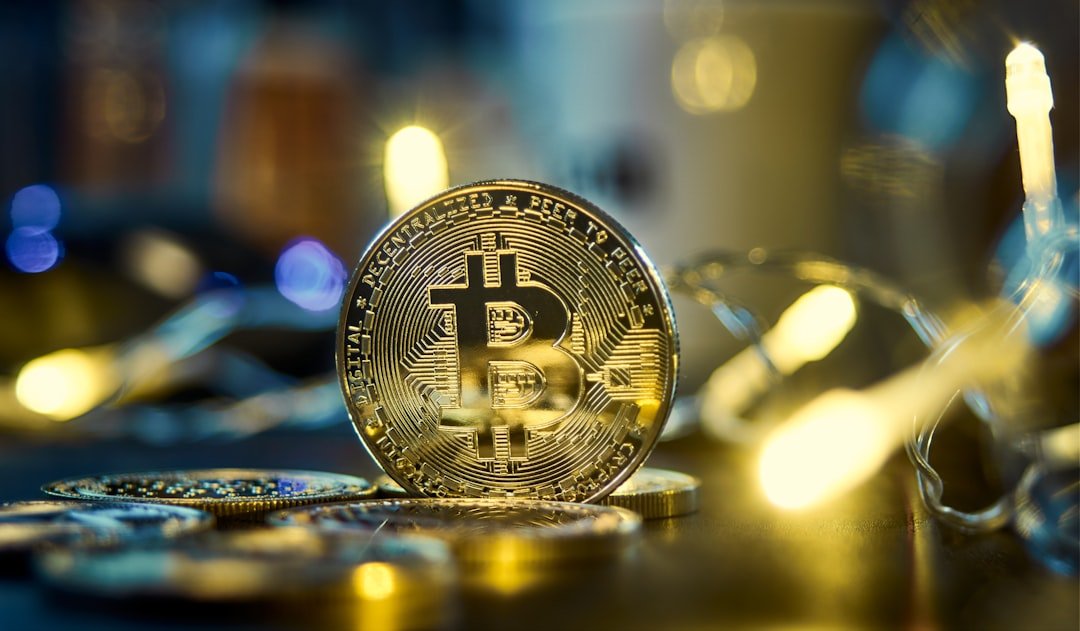
Photo by Michael Förtsch on Unsplash
What is Bitcoin? A Complete Beginner's Guide
Picture this: It's 2010. You're chatting with a tech-savvy friend who's excitedly telling you about something called "Bitcoin." He explains it's a new form of digital money, created by an anonymous entity, that promises to revolutionize finance. You nod politely, maybe even humor him for a bit, but deep down, you're thinking, "Digital money? Created by some unknown person? Sounds like Monopoly money or a fleeting internet fad." You smile, change the subject, and go about your day, completely unaware that you just heard about a technological and financial revolution in its infancy.
Fast forward to today. That "fad" is now a household name, making headlines globally. It has sparked countless conversations, debates, and even changed the financial landscape for entire nations. If you were like my friend – and many of us were – who dismissed Bitcoin years ago, you might be kicking yourself now. But more importantly, you might be asking: What exactly is Bitcoin? Why does it matter? And why is everyone still talking about it?
That's precisely why we're here. This isn't just another dry technical explanation. This is a journey, a story of an idea that blossomed into a global phenomenon. We're going to pull back the curtain on Bitcoin, explore its origins, understand how it works, and demystify its value. Think of me as your guide, your friend walking you through the fascinating world of cryptocurrency, making sure you grasp the essentials without getting lost in the technical weeds. By the end of this, you won't just know what Bitcoin is; you'll understand why it's important and how you can responsibly explore its potential.
The Genesis Story: A Response to Crisis and a Vision for Freedom
To truly understand Bitcoin, we must first go back in time, not just to its creation, but to the global mood that birthed it. The year was 2008. The world was reeling from one of the most severe financial crises in modern history. Banks, once seen as pillars of stability, crumbled or required massive government bailouts. Trust in traditional financial institutions and centralized authorities was at an all-time low. People felt powerless, their financial well-being seemingly at the mercy of opaque systems and distant decision-makers.
It was in this crucible of distrust and economic turmoil that a revolutionary idea took shape. On October 31, 2008, an individual or group operating under the pseudonym Satoshi Nakamoto published a whitepaper titled "Bitcoin: A Peer-to-Peer Electronic Cash System." This wasn't just a technical document; it was a manifesto for a new kind of money – money that could operate independently of banks, governments, or any single entity.
Imagine, for a moment, a world where you could send value to anyone, anywhere, at any time, without needing a middleman. No bank fees, no waiting days for international transfers, no risk of a government freezing your assets. This was the core vision. Satoshi Nakamoto wasn't just building a digital currency; they were building an alternative financial system founded on principles of decentralization, transparency, and individual sovereignty. The first Bitcoin block, known as the "genesis block," was mined on January 3, 2009. Within its code, Satoshi embedded a message: "The Times 03/Jan/2009 Chancellor on brink of second bailout for banks." It was a clear, poignant statement – a digital finger pointed at the very crisis Bitcoin was designed to circumvent. This wasn't just a currency; it was a quiet revolution disguised as code.
Peering Under the Hood: How Bitcoin Works Without a Central Bank
The idea of money without a bank sounds almost magical, doesn't it? How can something digital be secure, scarce, and trustworthy without a central authority overseeing it? This is where the true genius of Bitcoin lies, in its underlying technology: the blockchain.
Think of the blockchain as a massive, continuously growing digital ledger. But unlike the ledger in your bank, this one isn't kept secret in a vault. Instead, it's public, distributed, and maintained by thousands of computers – called "nodes" – all around the world. Every single Bitcoin transaction that has ever occurred is recorded on this ledger, visible to anyone who wishes to see it.
Here's how it works, simplified: When you send Bitcoin to someone, that transaction is broadcast to the network. Special computers, known as "miners," then compete to verify and bundle these new transactions into a "block." This competition involves solving a complex mathematical puzzle. The first miner to solve the puzzle gets to add their block of verified transactions to the existing chain of blocks – hence, "blockchain." As a reward for their work and computational power, they receive newly minted Bitcoin and transaction fees.
This process is incredibly clever because: 1. Decentralization: No single entity controls the ledger. Thousands of nodes verify transactions, making it virtually impossible for one party to manipulate the system. It's like having a global notary service run by a vast, distributed network of volunteers. 2. Immutability: Once a block of transactions is added to the blockchain, it's incredibly difficult to alter or remove. Each new block is cryptographically linked to the previous one, forming an unbreakable chain. If someone tried to tamper with an old transaction, they'd have to rewrite every subsequent block, which would require an unimaginable amount of computing power – far more than any single entity possesses. 3. Security: The cryptographic puzzles and distributed nature make the network incredibly robust against attacks. It's designed to be self-regulating and self-securing.
This elegant system ensures that Bitcoin can function as a truly peer-to-peer electronic cash system. It's a testament to computer science and cryptography, creating a financial network that is resilient, transparent, and censorship-resistant.
What Gives Bitcoin Its Spark? Unpacking Its Value Proposition
For many, the biggest question isn't how Bitcoin works, but why it has value. After all, it's just code, right? You can't hold it, touch it, or use it to buy groceries at every store (yet). This line of thinking, while understandable, often misses the fundamental drivers of Bitcoin's worth.
Let's break down why Bitcoin has become so valuable:
Scarcity: The Digital Gold Standard
Imagine digging for gold. It's hard work, and there's a finite amount of gold in the earth. This scarcity is a major reason why gold has held value for millennia. Bitcoin is designed with similar principles, but with an even more predictable supply. There will only ever be 21 million Bitcoins created. Ever. This hard cap makes Bitcoin deflationary by design, contrasting sharply with traditional fiat currencies, which can be printed endlessly by central banks, often leading to inflation and a loss of purchasing power over time. As the supply decreases (due to mining rewards halving approximately every four years, known as "halving events") and demand increases, its value tends to appreciate.Utility: A Global, Permissionless Financial Network
Beyond its scarcity, Bitcoin offers profound utility. It's a global payment network that operates 24/7, 365 days a year, without borders or intermediaries. Remittances: For millions around the world, sending money across borders is expensive and slow. Bitcoin offers a faster, cheaper alternative, allowing individuals to send value directly to family and friends with minimal fees. Censorship Resistance: In regions with oppressive regimes or unstable economies, Bitcoin provides a lifeline. It's an asset that cannot be easily seized, censored, or inflated away by governments. It offers financial freedom to those who need it most. Store of Value: For many, Bitcoin has become "digital gold" – a safe haven asset to protect wealth against inflation, economic uncertainty, and geopolitical instability. Companies like MicroStrategy have even added Bitcoin to their corporate treasuries, recognizing its potential as a long-term store of value.Decentralization and Security: Trust Through Mathematics
The fact that no single entity controls Bitcoin is a cornerstone of its value. It removes the need for trust in fallible human institutions and replaces it with trust in mathematics and cryptography. This decentralization makes it incredibly resilient to attacks, censorship, and corruption. The network's security, maintained by a vast global network of miners and nodes, is unparalleled in the digital world.Network Effect: The More, The Merrier
Like any revolutionary technology, Bitcoin benefits from a powerful network effect. The more users, developers, businesses, and institutions that adopt Bitcoin, the more valuable and useful it becomes. This positive feedback loop continues to drive its growth and solidify its position in the global financial landscape.Bitcoin in the Wild: From Niche Tech to Global Recognition
Bitcoin's journey from an obscure internet experiment to a recognized global asset has been nothing short of extraordinary. It’s no longer just tech enthusiasts talking about it; it's central bankers, multinational corporations, and even sovereign nations.
Consider El Salvador, for instance. In 2021, it became the first country in the world to adopt Bitcoin as legal tender. This wasn't merely a symbolic gesture; it was a bold step to offer financial inclusion to its unbanked population and reduce reliance on costly remittance services. While not without its challenges, El Salvador’s move highlighted Bitcoin's potential to empower nations and individuals outside the traditional financial system.
On the corporate front, companies like MicroStrategy, Square (now Block), and Tesla have added significant amounts of Bitcoin to their balance sheets. This move signals a growing institutional acceptance of Bitcoin as a legitimate treasury asset and a hedge against inflation. Wall Street giants are now offering Bitcoin-related products, and the emergence of Bitcoin ETFs (Exchange Traded Funds) in various countries has made it easier for traditional investors to gain exposure to this new asset class.
Furthermore, the development of technologies like the Lightning Network is supercharging Bitcoin's capabilities. The Lightning Network is a "layer two" solution built on top of the Bitcoin blockchain, designed to enable instant, low-cost micro-transactions. Imagine buying a coffee with Bitcoin, with the transaction settling in seconds for fractions of a penny – that's the promise of Lightning. This innovation addresses some of Bitcoin's earlier scalability concerns, pushing it closer to becoming a true everyday currency.
Bitcoin is carving out its dual identity: a robust "digital gold" for long-term wealth preservation and an evolving "digital cash" for swift, efficient payments. This ongoing evolution and increasing real-world integration underscore its growing importance beyond a mere speculative asset.
Your First Steps into the Bitcoin World: Practical Guidance
So, you've grasped the basics, understood its history, and appreciate its potential. Now, you might be thinking, "How do I actually get started?" It's simpler than you might imagine, but requires a thoughtful, cautious approach.
